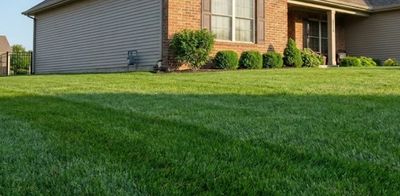
Lawn Fertilization in Wichita, Andover and Bel Aire
Wichita isn't exactly a paradise for grass. You have dealt with our "soil" - that raw-brick clay that alternates between a sloppy mess and a concrete slab depending on the Kansas sky. Fertilizer is key!
Lawn Fertilization in Wichita, Andover and Bel Aire Kansas
Wichita isn't exactly a paradise for grass. If you’ve spent any time in neighborhoods across Wichita, Bel Aire or Andover, you’ve dealt with our "soil" - that raw-brick clay that alternates between a sloppy mess and a concrete slab depending on the Kansas sky. Many homeowners view fertilizer as a "magic green pill" for any yellowing grass they see. They think the quick spread of pellets is the cure-all. But on the Kansas plains, keeping a lawn green is a marathon, not a sprint.
You must fuel it like an athlete. If you don't provide the correct nutrients exactly when the grass needs them, your investment is essentially dead on arrival. If you don’t hit the right nutrient balance at the exact right moment, you're just wasting your time. The investment disappears because the grass isn't being fed; it’s just getting a temporary sugar high it can't sustain. You’re literally feeding the wind, and that wind will carry your money three counties over before the grass even sees it.
At Lawn 316, we look at fertilization as a four-season strategy. You can't just treat the grass in May and expect it to survive August. Our local weather is too bipolar for that. To get a lawn that stays thick and green, you have to understand what the grass is doing during each phase of our crazy Kansas calendar.
The Spring Wake-Up Call
It is common to see Wichita yards that look incredible in April but look like a hay field by Father's Day. The reason is usually a poorly timed spring "wake-up" application. When you force a lawn to grow too fast too early, the blades outpace the roots. You get that "pop" of color everyone wants, but underneath that heavy clay, the roots are staying short and lazy. At Lawn 316, we treat the spring as a preparation phase for the summer. We want enough nitrogen to get the engine started, but not so much that the grass forgets to dig deep. It’s about balance. A foundation built in the spring determines if your lawn survives the "hair dryer" winds we get in June. We feed the grass for the long haul, not just for the immediate curb appeal.
The Summer Survival Phase
By the time June and July roll around, the "honeymoon phase" of spring is over. Wichita summers are brutal. We’re talking 100-degree days and weeks without a decent rain. This is where that heavy clay soil really starts to work against you. It bakes hard, and if you’ve used a cheap, fast-release fertilizer in the spring, your grass is going to be "hungry" right when the heat is at its worst.
Summer fertilization is a delicate dance. If you put down the wrong kind of nitrogen when it’s 95 degrees out, you will burn your lawn. I’ve seen it happen in nice neighborhoods all over Wichita, huge yellow streaks where someone got a little too heavy-handed with a spreader. When the Wichita sun starts baking our clay into a brick, we completely shift gears. We move to a slow-release formula that acts like a slow-drip IV for your turf. The last thing you want is a massive growth spurt when the wind feels like a hair dryer; that just burns through the plant’s energy and leaves it exhausted. We also lean heavily on iron during these months. Often, a lawn in Andover or Bel Aire that’s losing its color isn’t “hungry” - it’s just suffering from heat-stroke. A shot of iron is the pro secret here. It gives you that deep, emerald look without the dangerous "nitrogen surge" that usually ends up scorching a lawn to a crisp when the rain stops.
The Fall: The Real "Heavy Lifting" Season
If you ask most people when the best time to fertilize is, they’ll say "spring." They’re wrong. In Wichita, the most important feeding of the year happens in the fall. This is the part most novices miss entirely. When that Kansas air finally cools off in September, the grass stops trying to reach for the sky and starts digging down. It’s shifting its focus to the roots.
Since our Wichita clay is usually depleted or just too packed down for roots to breathe, this is the time to "bank" some serious energy. We use a blend heavy on potash - that’s Potassium to help the lawn build a root system thick enough to handle a hard freeze. If you skip this feeding, you’re basically sending your lawn into a Kansas winter with a completely empty stomach. It's a gamble you usually lose by March. At Lawn 316, we treat the fall application as the foundation for the entire next year. If you get the fall right, spring takes care of itself. This is also the prime time for overseeding through all of Wichita and the surrounding areas, so the fertilizer we use has to be compatible with new baby grass.
The Winterizer: Tucking the Lawn In
Most people think that once the mower is put away in November, the job is done. But a "Winterizer" application is what separates a good lawn from a great one. This isn't about making the grass grow; it’s about storage. We use a specific formula that the grass stores in its crown (the base of the plant). Throughout the winter, even when the grass looks brown and dormant, it’s still alive. It’s slowly sipping on those nutrients all winter long.
The real beauty of a winterizer is the lack of a "waiting period" come springtime. Since the energy is already packed into the base of the grass, it hits the ground running the moment the Wichita weather breaks. Most folks are out there in April trying to "jump-start" a dead-looking lawn, but yours will already be in motion. It’s essentially a biological head start. You’re giving the roots exactly what they need to beat the weeds to the punch before the spring "rush" even begins.
The "Clay Soil" Problem and pH
One thing you won't hear from the big-box stores is that Wichita soil often has a pH problem. Because our clay is so alkaline, the grass can’t always "eat" the fertilizer you’re putting down. You could dump the most expensive bag of nitrogen on your yard, but if the pH is off, it’s like trying to eat a steak through a straw.
We take the time to understand the local soil chemistry. Sometimes, we need to add sulfur or other amendments to "unlock" the nutrients that are already there. That’s the difference between a "spray and pray" service and a professional fertilization plan. We aren't just tossing pellets; we’re managing a biological system.
Why "Doing It Yourself" Usually Fails
I see it often in local neighborhoods, a well-meaning homeowner hauling five bags of those generic "Step 1" or "Step 2" mixes from the hardware store. They spend their entire Saturday afternoon behind a spreader, but by the time they’re done, half the investment is sitting on the concrete. In Wichita, the wind doesn't care about your lawn care plans; it’ll blow those light granules onto the driveway or into the neighbor’s gutter before they ever hit the dirt. You end up with "tiger stripes" in the grass where the spreader hit too heavy and absolutely nothing in the spots where the wind took over. It’s a lot of work for a very patchy result.
Wichita wind is no joke. If your spreader isn't calibrated perfectly, or if you don't know the exact square footage of your lawn, you’re either under-applying (which does nothing) or over-applying (which causes "burn" and runoff). Plus, there’s the issue of the "Big Box" blends. Those bags are made to be sold across the entire country. They aren't formulated for the specific mineral deficiencies we find in South Central Kansas and specifically Wichita. Fertilizer that is good for Los Angeles is not good for Wichita. At Lawn 316, our blends are selected specifically for the clay and the climate we deal with every day.
The Lawn 316 Difference
At the end of the day, a green yard in Wichita, Andover, or Bel Aire isn't something you can just buy in a bag at a warehouse store. It’s about timing. It’s about the equipment. It’s about actually knowing how our local dirt reacts when the humidity drops and the wind picks up. We live here, too. We’ve all felt that headache of watching a perfectly good lawn turn into a brown patch of dirt the second the July heat moves in. That’s why our four-season program exists. We spent years figuring out how to work with the Kansas environment instead of fighting a losing battle against it. We don't just toss products; we manage the local climate.
We handle the heavy lifting, the technical calibrations, and the messy storage of chemicals. You just get to enjoy a lawn that’s thick enough to crowd out the weeds and resilient enough to handle the Kansas sun. We take a lot of pride in being the experts our neighbors rely on to keep their property looking its best year-round.
If your lawn is looking a little tired, or if you’re just done with the "guesswork" of the hardware store aisles, we’d love to help. We offer free, no-obligation estimates for homeowners across the Wichita area. We can come out, take a look at your grass type and soil condition, and put together a plan that makes sense for your yard.
Call or text us at (316) 830-8144 or click the contact button above or you can fill out the form below!